Key Takeaways
- AI is changing how teams create, translate, and scale multilingual content, but speed is not the only goal.
- Multilingual content needs context: audience, brand voice, SEO intent, terminology, product details, market expectations, and cultural nuance.
- “Good enough” is not universal. It depends on the market, audience, content type, brand, industry, and purpose.
- Localisation is more than translation. It includes search behaviour, cultural fit, competitors, trust signals, UX, timing, and emotional relevance.
- The biggest risk is not only incorrect AI output. It is generic multilingual content scaled across markets.
- People still define what should be translated, localised, recreated, reviewed, or not scaled at all.
Who This Reflection Is For
This article is especially relevant for:
- marketing managers scaling multilingual content across markets;
- localisation managers designing AI-assisted workflows;
- SEO specialists working on multilingual visibility;
- ecommerce teams expanding internationally;
- founders and growth teams entering new markets;
- anyone working with AI, translation, localisation, and global content.
1. WMF Was Not Only a Stage Moment
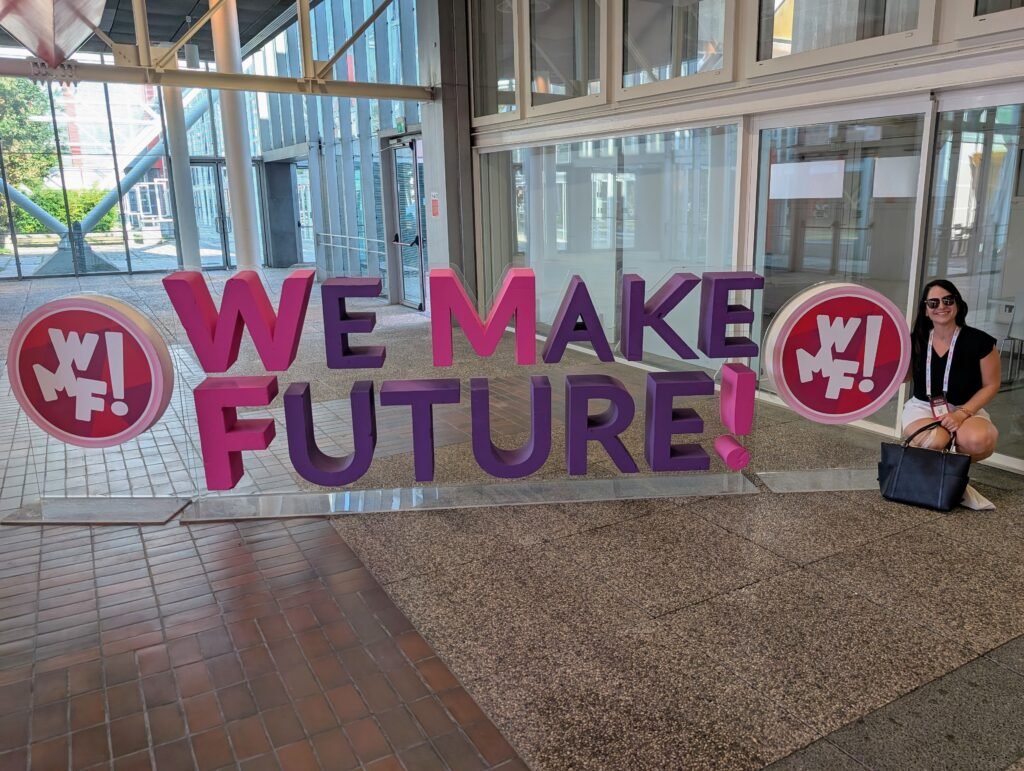
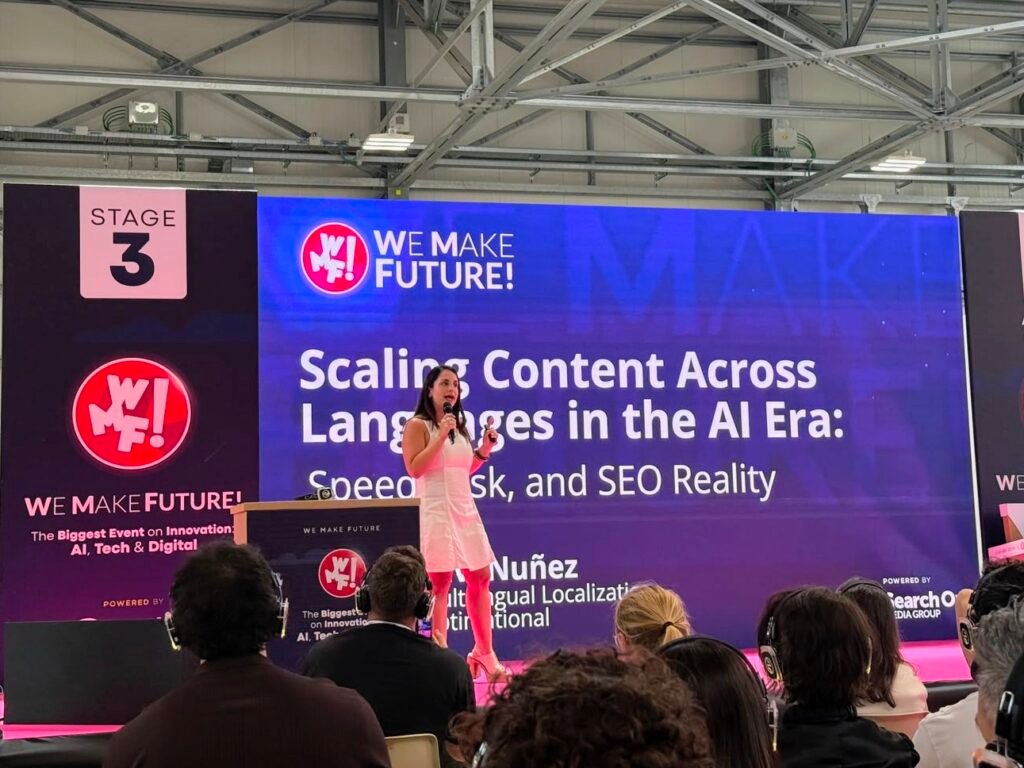
I went to WMF – We Make Future to speak about AI localisation, multilingual SEO, and scaling multilingual content across languages. The talk itself was about a topic I care about deeply: how businesses can use AI to expand multilingual content more strategically, without treating localisation as a simple translation task.
But what stayed with me most was not the stage, the slides, or the presentation itself. It was what happened after the talk. People raised questions that went beyond “Which AI tool should we use?” They wanted to understand how to use AI well, where it helps, where it creates risk, what should remain human, and who gets to decide what “good enough” means.
That shift felt important. A while ago, many AI conversations were still centred on replacement: will AI replace translators, writers, marketers, or creative teams? At WMF, I heard something more thoughtful. People are still curious about tools, of course, but they are also asking about responsibility, context, judgement, and quality. That tells me we may be moving past the peak of panic and into a more useful conversation.
2. The Future Of Localisation Is Not Only About Technology
AI is changing how we create, translate, adapt, and distribute multilingual content. It helps teams move faster, test more options, process larger volumes, and support workflows that would have been difficult to manage manually. But the future of localisation is not only about better technology. It is about the people using it and the responsibility they carry when helping businesses communicate across markets.
This is why localisation belongs in broader conversations about AI, technology, digital growth, and the future of global communication. Language is not just a delivery layer. It influences who can understand a message, who can find it, who can trust it, and who feels included by it.
At WMF, I kept coming back to the same idea: technology can help us reach more people, but it does not automatically help us communicate better. Communication still depends on context, care, judgement, and intent.
This connects to bigger issues too. Access, representation, inclusion, discrimination, human rights, visibility, education, conflict, and inequality may sound far from a marketing website or ecommerce localisation project. But they are all connected by one basic question: who gets understood?
Of course, not every multilingual content project carries the same social weight. Translating a product page is not the same as translating health information, legal rights, or crisis communication. But the principle remains: language affects access. Visibility affects opportunity. Technology affects whose voices and needs are considered.
That is why responsibility was the emotional takeaway from WMF for me. AI can scale multilingual content, but people still need to decide whether that content is useful, accurate, inclusive, trustworthy, and worth scaling in the first place.
3. Some Of The Questions People Asked After My Talk
The most useful part of speaking at WMF was not delivering a finished message. It was hearing what people wanted to explore afterwards. The conversations felt practical, but also more reflective than many AI conversations I have had over the last few years.
What Should We Keep In Mind When Expanding To A New Market?
One of the questions after the talk was what a company should consider before translating its website for a new market. It is a common question, and it is also one of the easiest places to underestimate localisation.
My answer was: do not start with translation. Start with the market.
Before translating a website, a team should understand how people in that market search, compare, evaluate, and build trust. The same product may solve the same problem, but the way people describe that problem can change. Local competitors may frame the solution differently. The proof points that work in one market may feel weak in another. Even the same value proposition may need to be adjusted if local users have different expectations, budgets, concerns, or decision-making habits.
For example, entering a new market may require looking at:
- local search behaviour and keyword intent;
- competitors and how they position similar offers;
- audience expectations around trust, pricing, proof, and support;
- local examples, references, currencies, formats, and regulations;
- whether the original value proposition still feels relevant;
- whether the tone sounds natural or obviously translated.
This is where multilingual SEO localisation becomes essential. A keyword can translate neatly and still fail because people do not search that way. A landing page can be linguistically accurate and still feel unconvincing because it does not match local expectations. A call to action can work well in one market and feel too vague, too direct, or too unfamiliar in another.
So the real question is not “How do we translate this website?” The better question is: “What does this market need to understand, trust, and act?”
Are LLMs Better For Creative Multilingual Content?
Another question was whether large language models are better for creative content. I understand why this comes up often. LLMs can be very useful when the task involves ideation, tone variations, headlines, outlines, summaries, drafts, or different creative angles.
They can help teams move from a blank page to a working direction faster. They can also help explore how a message might sound in different tones, for different audiences, or across different channels. That flexibility is valuable, especially for content and marketing teams that need to produce more with limited time.
But creative multilingual content does not work just because it sounds fluent.
A campaign message, brand story, landing page hero, or social post depends on timing, emotion, audience expectations, cultural references, intent, and brand voice. AI can generate options, but someone still needs to know which option fits the brand, the market, and the moment.
This is especially important in multilingual content. Creative localisation is not only about translating the original idea. Sometimes the idea needs to be adapted. Sometimes it needs to be rebuilt. Sometimes the safest option is not the most effective one. And sometimes the most literal version is technically correct but emotionally flat.
AI can support creative work, but it does not replace the need to understand what the content is supposed to do. Is it meant to reassure? Persuade? Explain? Entertain? Build trust? Start a conversation? Move someone closer to a decision?
Without that intent, creative multilingual content becomes easy to scale and hard to remember.
Will AI Fully Replace Translators?
The question of replacement still appears in almost every AI and localisation discussion. My answer has not changed: no, especially not in areas where nuance, trust, regulation, culture, persuasion, SEO visibility, or brand voice matter.
AI is changing translation work. That is undeniable. It is changing workflows, expectations, pricing models, review steps, quality control, and the role of human linguists. It can create useful first drafts, support terminology checks, help compare options, and speed up repetitive tasks.
But producing language is not the same as understanding what that language is supposed to do.
A translator, editor, reviewer, SEO specialist, or localisation manager is not only checking whether the words are correct. They are checking meaning, purpose, tone, risk, market fit, audience expectations, and business context. They are also checking what is missing, what sounds generic, what feels culturally off, and what may be technically accurate but strategically weak.
That distinction matters more as multilingual content scales. When AI helps teams produce more content faster, the risk is not only one mistranslated sentence. The bigger risk is generic multilingual content multiplied across markets.
#OptimationalTip:
AI output should not be judged only by fluency. For multilingual content, teams also need to review accuracy, purpose, tone, search intent, cultural fit, brand voice, and risk.
4. What I Would Add To My WMF Talk Now
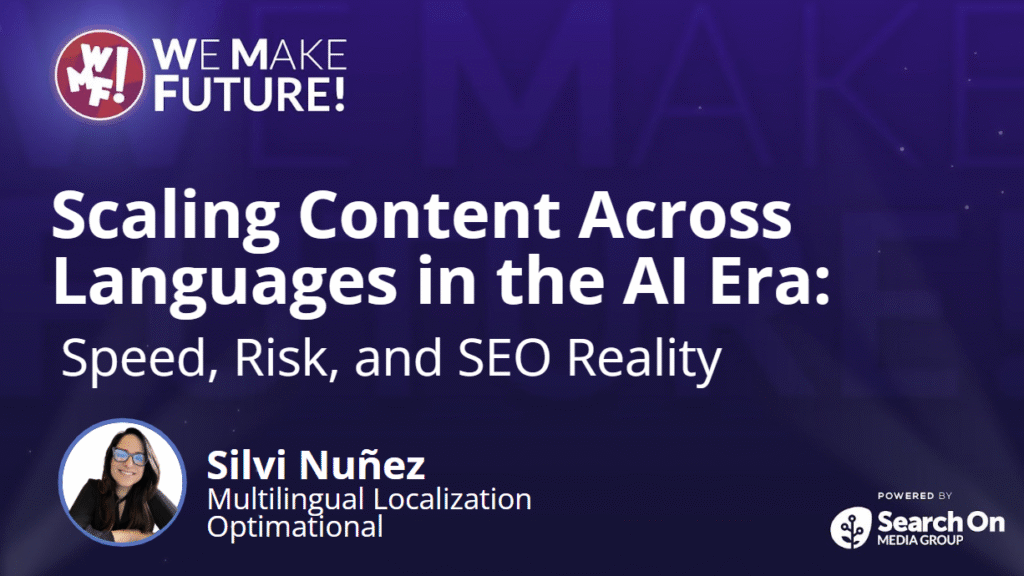
If I gave the WMF talk again, I would emphasise one point more clearly: AI works better when it has context, but a human still needs to decide what context matters.
Context includes much more than the source text. It includes audience, brand voice, SEO intent, terminology, product details, market expectations, previous approved content, competitor positioning, examples, restrictions, and the goal of the content. Without that context, AI often produces something fluent but average. With better context, it becomes more useful, but it still needs human direction.
The most important question is not only “Can AI produce this?” It is “What would make this good enough for this purpose?”
And “good enough” is not universal.
| Content Type | What “Good Enough” May Require |
| Internal documentation | Accuracy, clarity, terminology consistency, and speed. |
| Product descriptions | Correct details, local terminology, useful structure, and conversion clarity. |
| SEO blog content | Local search intent, metadata, headings, examples, internal links, and topical relevance. |
| Brand campaigns | Emotional fit, cultural context, originality, timing, and strong brand voice. |
| Legal or regulated content | Specialist review, risk control, precision, and compliance awareness. |
| Ecommerce category pages | Search behaviour, trust signals, product terminology, UX, and local buying expectations. |
This is where human judgement becomes central. Someone needs to define quality. Someone needs to decide what should be translated, localised, recreated, or not scaled at all. Someone needs to prevent clichés, generic phrasing, and content that looks multilingual on the surface but does not feel relevant in the market.
Not every piece of content deserves to travel. Some content is too specific to one market. Some needs to be rebuilt from the ground up. Some is useful as a starting point but not as a final structure. Some should stay consistent because it protects the brand. Some should adapt because consistency would make it less effective.
Scaling multilingual content is not only about producing more. It is about choosing better.
Visual Suggestion: Use a photo of a slide, laptop, notes, or speaking moment near this section to connect the insight back to the talk.
5. Scaling Multilingual Content Is Not Just A Workflow Issue
Workflows matter. A lot. If a team wants to scale multilingual content across languages, it needs structure: glossaries, style guides, QA steps, review models, approval flows, clear ownership, and a realistic understanding of risk. But scaling multilingual content is not only a workflow issue. It is also a business, marketing, SEO, cultural, and human decision.
The workflow tells you how content moves. Strategy tells you whether that content should move, where it should go, how it should change, and what it needs to achieve when it arrives.
For marketing managers, localisation managers, SEO specialists, and ecommerce teams, this means asking better questions before scaling multilingual content:
- Are we scaling the right pages, campaigns, or assets?
- Do we understand local search intent, or are we translating keywords literally?
- Are we adapting the message, or only translating the words?
- Do local users trust the way this content sounds, looks, and behaves?
- Are we considering local competitors and category expectations?
- Does the content match local buying habits, objections, and decision triggers?
- Where can AI safely support drafting, translation, research, or QA?
- Where is human review essential because nuance, trust, or risk matter?
- What should stay consistent across markets?
- What should adapt to feel more relevant locally?
These questions help teams avoid one of the biggest risks of AI-assisted scale: producing more multilingual content than they can meaningfully control.
AI can support the workflow in many useful ways. It can help with first drafts, rewriting, summaries, multilingual variations, terminology suggestions, QA support, prompt-based checks, content repurposing, and early research. But it should not be the only layer of decision-making.
Human expertise is still needed to decide what the multilingual content is for, how it should sound, what local users need, what the brand should protect, and where quality cannot be compromised.
In short, AI can help teams move faster. Localisation helps them move with more relevance.
6. Practical Questions Before Scaling Multilingual Content
A practical way to approach multilingual content is to separate production questions from judgement questions. Production questions help teams move efficiently. Judgement questions help teams avoid scaling the wrong thing.
| Before Asking… | Ask This First |
| How fast can we translate this? | Should this content be translated, localised, recreated, or left as it is? |
| Which AI tool should we use? | What context does the tool need to produce useful output? |
| Can we publish this with light review? | What is the risk if this content is wrong, generic, or culturally weak? |
| Can we use the same message everywhere? | What should stay consistent, and what should adapt by market? |
| Can AI write the first draft? | Who will define quality and approve the final version? |
| Can we scale all markets at once? | Which markets, pages, or content types deserve priority? |
This is where multilingual content becomes more than a language task. It becomes part of growth strategy, SEO strategy, brand management, customer experience, and market entry planning.
For ecommerce teams, this might mean adapting category pages based on local buying behaviour. For SEO teams, it may mean researching search intent from scratch instead of translating an English keyword list. For marketers, it may mean rebuilding a campaign message so it feels emotionally relevant. For localisation managers, it may mean creating different review levels depending on risk, content type, and market importance.
#OptimationalTip:
Do not use the same AI-assisted workflow for every content type. Low-risk internal content, SEO-critical pages, brand campaigns, and regulated content need different levels of context, review, and approval.
7. People And Moments That Stayed With Me
Technology events are never only about technology. They are also about people, dialogue, and shared questions. A few moments from WMF stayed with me because they reflected the bigger theme I kept returning to after my talk: the future is not only built by tools, but by the people deciding how those tools are used.
Federico Sbandi, CEO of Digital Combat Agency, explored the point where executive communication and influencer logic meet. What I took from his session was the tension between visibility and responsibility: leaders want to sound more human and platform-native, but communication still carries reputational weight. That connects to multilingual content too. Scaling across markets is not only about reaching more people; it is also about protecting trust, tone, and credibility in every language.
Jeanniey Walden, founder of Liftoff Enterprises, spoke about trust as something AI cannot create on its own. Her session, Trust Is The New Algorithm: Why The Brands Winning In 2026 Are Measuring What AI Cannot See, stayed with me because it applies directly to multilingual content. A brand can translate more pages, produce more posts, and scale more versions across markets, but people still decide whether the experience feels real, relevant, and trustworthy.
Lučka Bibič, Head of Article Pipeline Management at Springer Nature, gave me another way to think about AI and human judgement. Her talk, From Spider Venom To Strategy, explored how AI changes not only what teams do, but how they understand their own value. That connects strongly to localisation. When multilingual output becomes easier to produce, judgement becomes more important: knowing what context matters, where nuance lives, and how to use AI without losing the human experience behind the content.
For me, the connection between these talks was clear. Trust, judgement, identity, visibility, and responsibility are not side topics in AI. They are part of what determines whether multilingual content actually works across markets.
8. The Work Behind The Stage
I was the one on stage, but the thinking behind the talk also comes from the team behind the work.
At Optimational, these questions are part of our daily conversations. How much context does an AI-assisted workflow need? When is machine translation useful? When does multilingual content need human-led localisation? How do we protect brand voice across languages? How do we help clients scale without creating generic multilingual content? How do we balance speed, quality, cost, and risk?
The answers are not always the same. They change depending on the client, market, industry, content type, audience, and goal. That is why the work is not only about applying a fixed process. It is about testing, adjusting, reviewing, learning, and asking better questions.
That is also what makes localisation interesting right now. The tools are changing quickly, but the deeper challenge remains human: how do we help businesses communicate in ways that are clearer, more relevant, and more useful for the people they want to reach?
For me, WMF was a reminder that the future of multilingual content will not be defined only by the most advanced technology. It will also be defined by the teams that know how to use that technology with care.
9. Final Thoughts: Speed Is Not The Only Goal
AI can help us scale multilingual content. It can help teams translate faster, draft faster, test more ideas, and manage more multilingual assets. That is valuable, especially for businesses trying to grow across markets with limited time and resources.
But speed is not the only goal.
The real question is whether we are using these tools to communicate better. Are we helping people understand? Are we making content more accessible? Are we building trust across languages and cultures? Are we adapting meaning, or only multiplying words? Are we making space for more people to participate, discover, compare, learn, and feel represented?
That is what stayed with me after WMF. Not only the possibilities of AI, but the responsibility that comes with them.
AI can scale multilingual content. People still define what matters.
Curious to hear how other teams are approaching this.